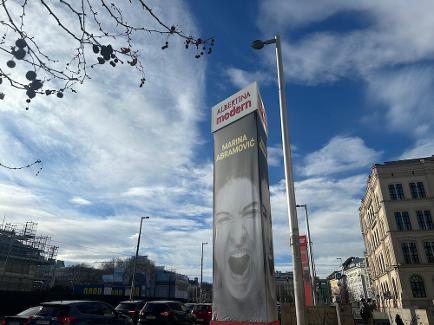
I finally gave in. I went to Abramovic's show in Albertina Modern after avoiding it for a while, in several opportunities but I saw that some of the works would be reactivated live, so the curiosity finally slipped in. I felt rather indifferent with the curatorial direction as I thought giving so much emphasis on Rhythm 0 was unnecessary. It is for me a work which hype is overdone. The display of the objects (assumingly all of them were replicas and not of the performance relic anyway) made me feel nothing. The documentation especially the video was also useless. I don't know, but I trust her and the writings around the work that patrons did load the gun and attempted to shoot her. Intention aside, the gesture of doing so did not reflect anything; but not that it matters for me. I have learnt of the piece way beforeI saw the 'installation' and for me hearing and reading and learning about it felt more real.
The Lips of Thomas room, together with the reenactment stage for Luminosity and Rhythm 5 was a wonderful one.It is afterall one of my favorite work of her, especially when she reencated it again during Seven Easy Pieces (which is my most favorite project; which unfortunately was not shown in its entirety in the show).The reenactment of Luminosity was alright, I guess but I felt distanced. One thing though, I was gld to see the video documentation of the work which was played in a square-box TV was switched off as a body took the floating stage on the wall. The framing of gallery light was also beautiful, but I wish it were in a continuous loop and rotation; or even sporadically that audience need not plan to come at 'specific' time per se. I wish the image I was observing was a audience looking at the work as an artwork, just like the others it shared a room with, not as a performance where we waited and sat on the floor and watched until the body left.
I also had the privilege to witness Imponderabilia and Art Must Be Beautiful; the latter was quite exciting because I have not heard of it being restaged in other shows. But may i say, they were horrible. They were disappointing to say the least; not because of the performers and the bodies that activated the work; for they are mere tools, unlike Ambramovic in Seven Easy Pieces. But let's unpack this.
1. The two works were presented within 2 meters of each other; at the same time. Within the same room, bigger than life-sized projections of Abramovic's performance with Ulay videos producing noise and it even included Abramovic's Art Must Be Beautiful video; which to be fair, I had left the room before a clash between the live spoken words with her echoing. But let's give it benefit of a doubt, me being generous here, that the video wouldn't have been played for the hour a long-haired male body brushing his long hair, in a corner of the room, with a video camera about 1 metre in front of his face, documenting the situation. And all this while, just a meter away, two naked bodies were blocking an already narrow entrance, creating a one-way path system as I witnessed a museum usher gently asking audience to experience the work from the other room. The curation of the space was a complete disaster. There was no sensitivity towards the work but simply an activation. There was no regards to the bodies as well, it is almost like installing a work on paper while not wearing clean gloves. The lack of consideration was apparent.
2. There were also a lot of distractions. I believe that it was for care and safekeeping towards the bodies (which through space alone it was also clear that they were not taken into high regards) audience were not allowed to use their phones in the space. Understandably so because of the presence of nude bodies but the policing was unnecessarily strict. Museum ushers were eyeing every audience. We were watching the work and being watched by half a dozen of security with piercing gaze, trying to catch anyone with their phones out. As a person who ushers professionally in theatre, I always give a bit of leeway for the use of phone camera, not because I trust them (to be fair, theater goers can not be trusted at all man....) but because extreme policing results in uinntended gaze that create tension. A performance space is after all, 'sacred' And I feel in this regard, I prioritize audience experience than performers' 'safety'; not in an ignorant manner but looking back into what is the work for, or what is the reenactment for.
Generally, I feel a sense of pity towards the performers, as their individualities were totally stripped, way more naked compared to their physical bodies. In my opinion, what Abramovic did for Seven Easy Pieces were absolute genius. She even came up with several rules in honor of the origins of those existing performance works; both the artists and the works themselves. She was not trapped and caged in the pieces (which often the case with performance art) but her individuality shone. But what the institute has done with her reenactment is that hiring puppets that have been given nothing but instructions and a facade of safety and wellbeing. They were shells, and so were we as audience. And it did not work for me.
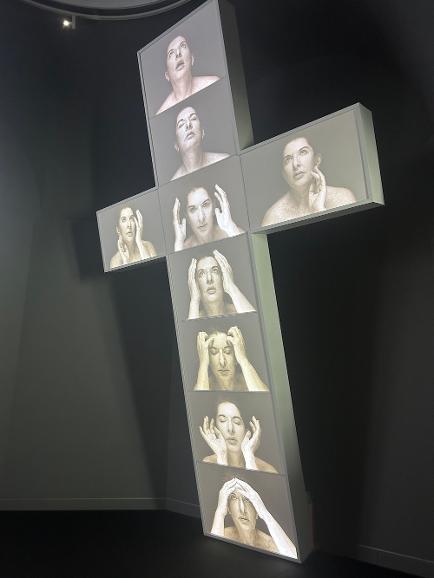
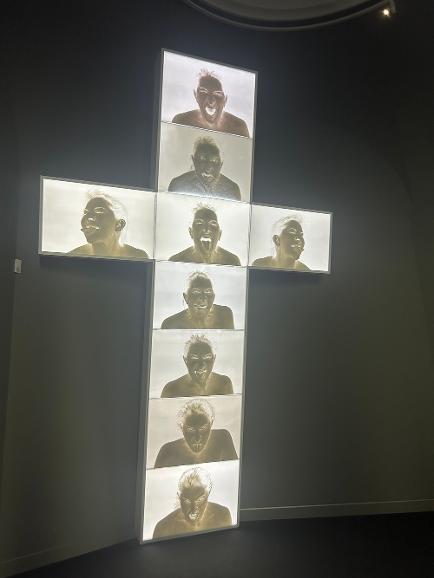
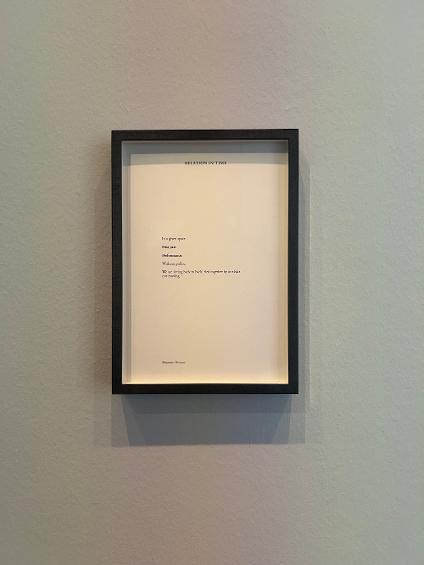
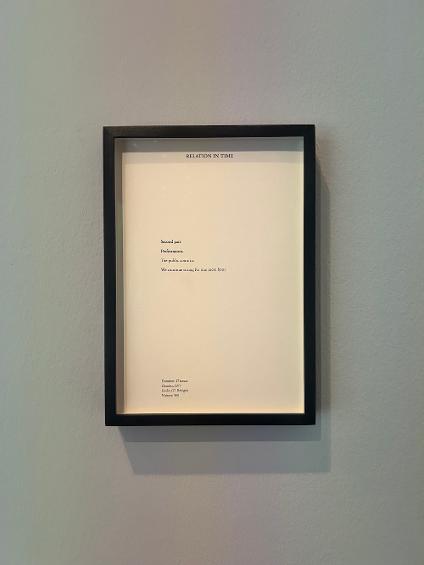
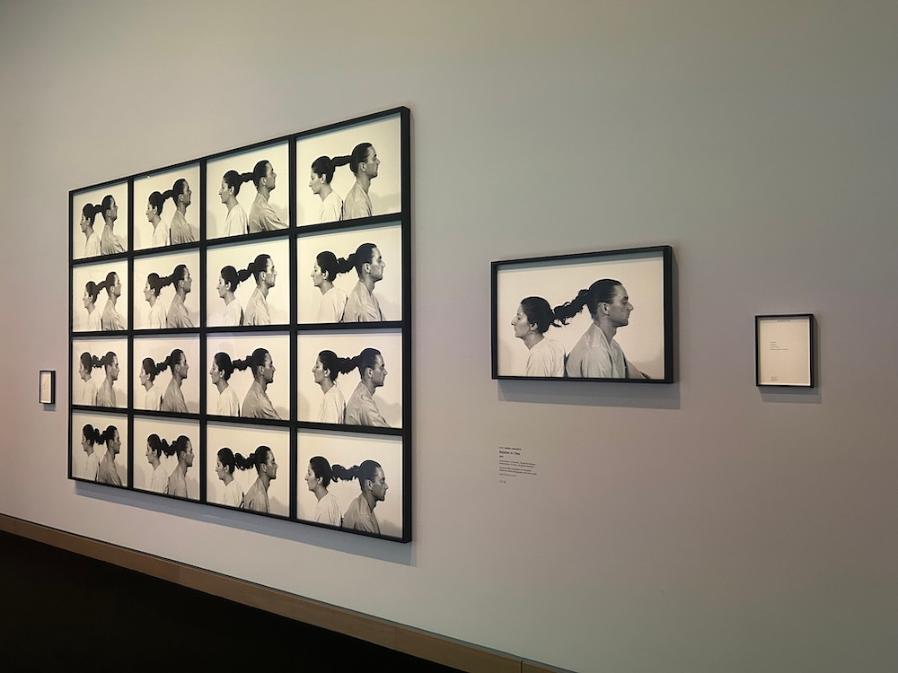
Having said that, I enjoyed the show in general, though I do not really fancy the crystal pieces. The two crosses which I believe is generally quite a new piece of hers were fantastic but the documentation of Relation of Time was stunning. The format os the presentation demonstrated its age, its quietness, its instructions and formula. But above all, it gave me a realization; it does not need to be reenact for it to remain relevant. Even as a performance maker, I recognize the limitation of the craft as much as its strength and potential. Not everything needs to be a performance, neither need to be accompanied by a performance. Because many times, the lack of bodies amongst documentation makes their presences felt more intensely.
So the week continued on with another great deal of disappointment as. I came across a video of Felix Gonzalez-Torres' Untitled (Go-go Dancing Platform) with a non-binary (or at least what I assume they were) body. Now, let me make my point clear: if the conversation shuts there by the pretense that I am transphobic, that is the very reason why we as queer community as a whole is fucked. Because our attention (also often blamed by 'trauma') is diverted so very quickly to fear and hatred at the expense of missing the a more deeply rooted issue. Visibility is invisibility when it is done so for the purpose of representation. Representation for me, unfortunately after layers of politically and morally correct behaviors, is a facade, cosmetic and, within the context of art, and FGT's work, it was offensive. The attempt to represent highlights two things for me:
1. The emphasis that visibility is the only thing that matter. The body has the impression that it constantly needs to be highlighted, not just bodies, but THE bodies. With this, it jeopardizes performance as a pick-me form of art, where what important is that the body is seen. FGT's work can no longer be consumed without having the politicized body presented, because its formula has been broken. The context of the breathing figure has been replaced from something that is generally idolized (and please, we have to recognize that the go-go dancer body is still celebrated aesthetically regardless whether you are of in whichever gender and sexuality spectrum) to something that is, although can equally be idolized, politicized, aor worse, politicized. The context of the work, which mind if I add, historical work, has changed and we can no longer consume the piece without expecting what kind of bodies are going to be presented there, because the body which also appear only so very fleeting, dictate the work. In this context, the body is most important which is antithesis of FGT's sculpture; which then leads me to the second point:
2. Distrust. One, the curator does not trust their audience because they have contextualized the work (in relation to today's social context of course) to be consumed in a singular palate. It is no longer a learning opportunity through experiment and failure, but a a predetermined result. FGT's sculpture has been turned from a conversation surrounding AIDS, hierarchy and potentially critique on masculinity has been shifted from being a tombstone into a rave party. The unpredictability of what bodies will turn up next result in, ironically, preordained context. The rich mystery is reduced to plain self-mastubation. And the decision is a mockery towards minimalism and abstraction as a viable vocabulary to engage in contemporary issues. Audience were not trusted to form their own opinion, whether one agrees or otherwise, but spoon-fed with propaganda.

I was also introduced to the work of Charlotte Gash who had a screening of her recent latest film She's Not Home at an artist-run space Pilot which she offered an introductory action before the film began. It was a film about her experience of getting a full-year studio and flat scholarship which unfortunately turned up to be traumatic due to difficult tenant and neighbors. She shared the background of her film and how it had taken her such a ong time to be able to finish it while making a bowl of mayonnaise. Wearing a white dress made out of the same fabric/canvas the film was projected to she shared how much she loves mayonnaise and eventually gifted small jars of them to friends who had helped her making the film.
I find beauty in that despite me being a complete foreign and outsider of the whole setting. It was a more casual, friend meetings sort of screening which ended up to be a feature film hence I did not stay for the entire thing. (Just did not have the mental preparation to sit through the entirety of it).
With the recent trend of queer performances with their pick me attitude and facades of care, I begin to feel like humility is a weakness. Look at me is the expected attitude of performance art instead of talk to me. Performance art has become an instruction instead of invitation. I feel is it still possible to perform because it is a craft and not a social media content. I think i will be asking this questions a lot these days.
I attended a workshop by Malcom Manning at the Tanzquartier and the objection was simple. To feel better and lighter than before the workshop. No social context. No look at me encouragement. No emotional and mental validation. But suggestion of gestures and breathing. And it was effective. I felt better than before I walked in. I want to make performances like this.

But for me, the film itself was brilliant. It was comical, funny, purposefully B-grade and despite the 'i'm an artist' energy, it recognizes the limitations of one's act. Pilot was also a domestic space, or at least its interior seems to suggest so. The film then transcends the screen to reality and physicality which is echoed by Charlotte wearing the canvas dress. The action despite random and its meaning questionable, looks relevant. As an audience, I was presented with a situation where the artist trusted me in reaching my own conclusion, or at least journeying my own path towards that. Her determination in churning the mayonnaise from scratch with sweat pouring as by-product of the gesture expresses genuinity. Simple act.
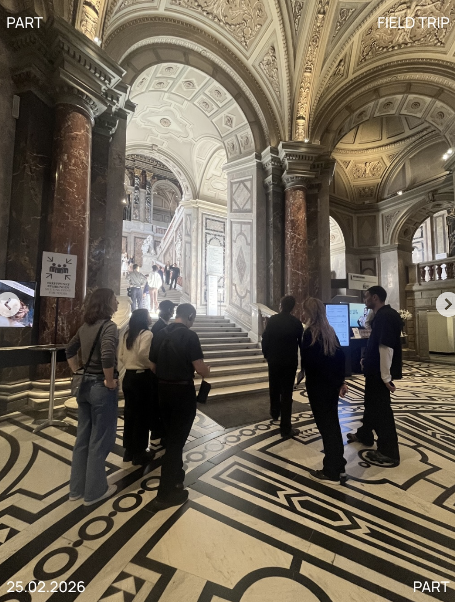
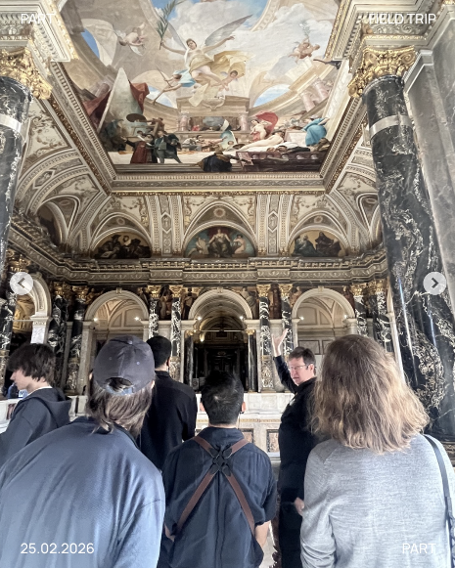
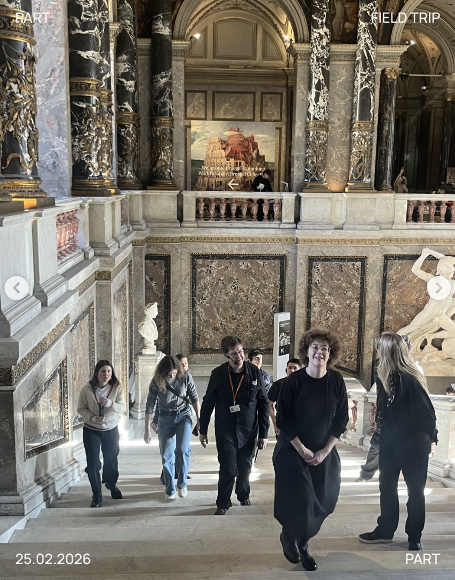
Part also organized a museum visit to the Art History Museum with a private tour led by Rolf Wienkotter, one of the senior art historian there.We were shared backgrounds, relevance and stories from the various collections, particularly his own personal favorite, Pieter Bruegel, Johannes Vemeer and the Kunstkammer collection. I enjoyed the tour very much that Rolf made me wanting to see and hear more. I have not been the most attentive to historical artefacts and relics of the past but his knowledge tickled further interest; which challenges my own practice and my own work; can I ever achieve similar interest in others.
But what fascinated me the most was how my own body gesture navigated the space. There was the main hall with an extravagant canopy and stairs, where I was constantly tilting my head up, squeezing the back of my neck resulting in slight pain and discomfort in the attempt to look at art. I find the situation regardless how uncomfortable it was, enhanced my own experience ion looking at both the work but also the architectural and interior design of the museum.
Again, the experience led me to question performative elements of a museum or recreational or even sigh-seeing visits. What is consumed, what is put on display and how, what stories are we meant to believe, what is provided and what is then continued in each visitors, which then extends to who and whom these visitors and and with.


It snow! But it has been almost a month now.
There are more things that happened the past two weeks especially in regards to my own development of works. I had responded to several open calls, which I have not been to for almost a year. Went to see some exciting shows in museums which I will cover in the next post. But ultimately, I have been making works again. It has been a good, positive feeling this process of healing and I hope it continues for the next two months at the very least.

